Link copied!
AI
Anthropic publishes a 52-prompt library directly inside the Claude Code documentation

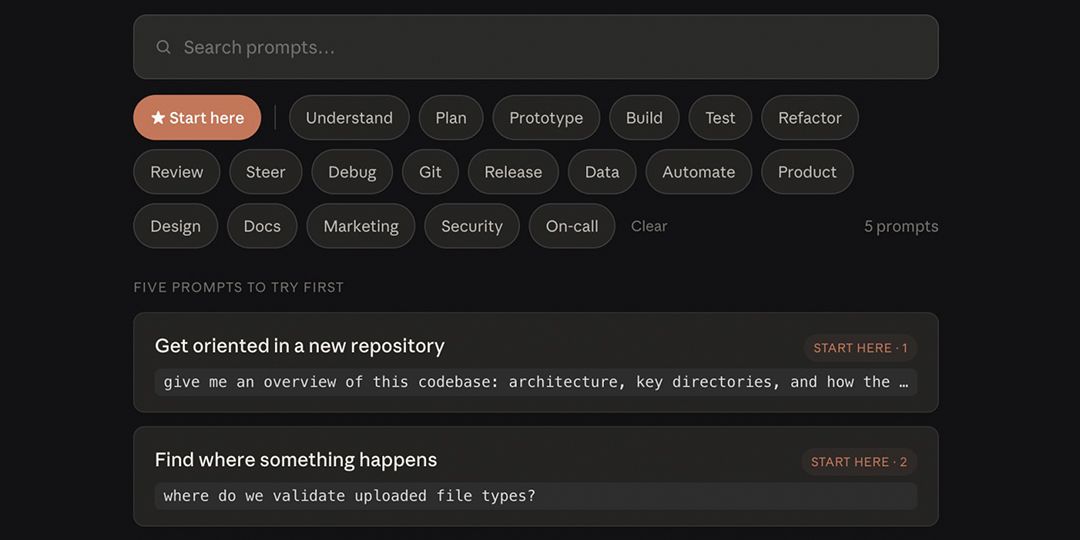
Anthropic has published a prompt library directly within the Claude Code documentation, offering developers a ready-made collection of copy-paste prompts for working with the coding assistant.
The library currently contains 52 prompts, grouped by task type, each accompanied by an explanation of why and how the approach works.
According to the documentation, the prompts are drawn from several existing Anthropic resources, including guides on common workflows, general best practices, and case studies on how Anthropic’s own teams use Claude Code internally. Rather than being rigid scripts, the prompts are meant as starting points that developers can adapt to their own projects and coding style.
Each entry includes an optional “Why this works” explanation, revealing the underlying pattern behind the prompt so users can construct similar ones on their own rather than relying solely on the provided examples. The library covers the full development cycle, from initial planning and codebase exploration to building, testing, and shipping code.
A reference built from real internal usage
The move is aimed at developers who are new to Claude Code or unsure how to phrase requests effectively, giving them a practical reference instead of having to write every prompt from scratch.
Publishing internal usage patterns rather than just generic examples is the more useful part of this release. Prompts pulled from how Anthropic’s own teams actually work day to day tend to reflect real friction points rather than idealized demo scenarios.
For teams building content, workflows, or internal tooling around Claude Code, a curated reference like this shortens the ramp-up period considerably compared to reverse-engineering effective prompts through trial and error. Use from here.
“
The “Why this works” layer is doing more work than it looks like — it turns the library from a copy-paste cheat sheet into something closer to a teaching tool, since developers can extract the underlying pattern once and reuse it across tasks the library does not explicitly cover.

Related tags


Share
SUBSCRIBE TO OUR PRIVATE CASES AND USEFUL TIPS
Subscribe to our newsletter, get only exclusive content and weekly digests, no any spam!
By providing my email, I accept the Privacy Policy.